

Automatic Lathe Solutions Streamlining Modern Manufacturing
2026-11-16
Behind every flawlessly machined component in today's high-speed production lines is a revolution that many overlook—the quiet takeover of automatic lathe solutions. While traditional turning centers still clutter factory floors, a smarter generation of CNC-driven automation is redefining what 'streamlined' truly means. At the heart of this shift is WINNRUI CNC, where precision isn't just a specification but a built-in instinct. In this post, we'll unpack how integrating automatic lathe technology turns bottlenecks into breakthroughs, and why the future of modern manufacturing hinges on decisions made right now.
Why automatic lathes are reshaping factory floors
The shift toward automatic lathes is rewriting the rhythm of production lines. These machines don’t just speed up turning—they collapse multiple operations into single, unattended cycles, freeing operators to handle higher-value tasks while the lathe runs bar after bar with micron-level consistency. The result is a floor that feels less crowded, less interrupted, and far more predictable.
What makes this transformation stick is how automatic lathes absorb complexity that used to require separate setups and skilled intervention. Live tooling, sub-spindles, and in-process gauging allow a single machine to turn, mill, drill, and measure without human touchpoints. That means fewer work-in-progress piles, shorter changeover windows, and a layout that adapts overnight instead of over weeks.
Even the talent equation is changing. Shops that once hunted for elusive manual turning experts now build teams around programmer-operators who monitor cells rather than baby-sit cuts. This reshapes not just the equipment roster but the entire flow of work, making high-mix, low-volume production both scalable and repeatable—a reality older factories could only sketch on a whiteboard.
The quiet shift from manual to lights‑out machining
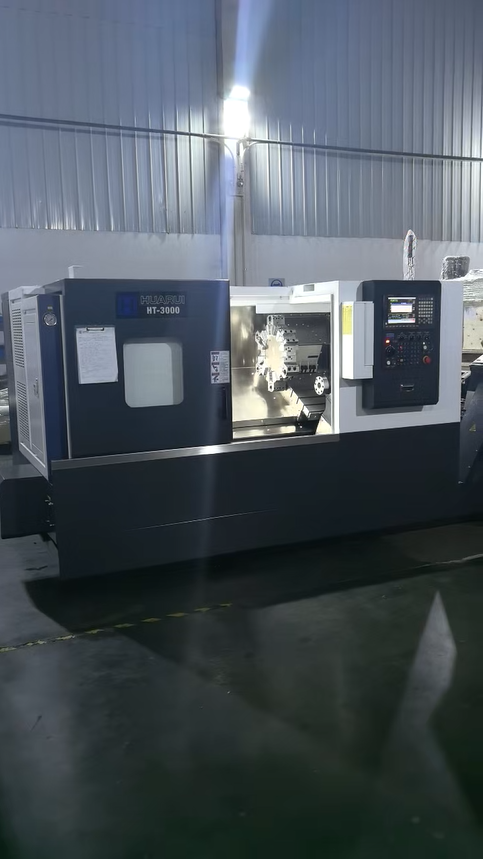
For decades, machining has been an intensely human craft. Even with CNC automation, a skilled operator hovers nearby—listening for chatter, swapping tools, wiping away chips. That familiar presence is fading now, not with a dramatic announcement, but a gradual withdrawal. Shops are discovering that their machines can run entire shifts in the dark, with nobody pacing the aisle. It started with smarter tool monitoring and automated in-process gauging, then crept into robotic tending and software that predicts insert life. Suddenly, that 2 a.m. ghost shift isn't a risk anymore; it's just another productive block of spindle hours.
The reasons for the move are almost too pragmatic to argue against. A multi-axis machine isn't cheap, and letting it sit idle for twelve hours out of every twenty-four gnaws at margins. Beyond the raw economics, there’s a quieter motivation: consistency. A lights-out process forces you to remove the last variables—nobody misjudges an offset at 3 a.m., nobody skips a deburring pass because they're tired. The cell runs the same program, with the same feeds and speeds, checked by probing routines that won't let a bad part pass. When a shop finally trusts the process enough to turn off the lights, they’ve already built a fortress around quality.
Getting there, however, demands a reversal of conventional thinking. You can't just lock the door and hope nothing goes wrong. Every potential failure mode—coolant concentration drifting, a chip wrapping around a drill, a slight variance in stock material—needs a pre-planned response. The machine must be able to detect a broken tool, call up a sister tool, and keep moving without human intervention. Chip management becomes an obsession; a tangle of stringy aluminum can scrap an entire night's production. For those who make the shift successfully, the workshop feels different when you visit during the day. It hums with a steady, unattended rhythm, and the machinist's role has evolved into something more strategic: process architect, data reviewer, the person who fixes the problem before it ever happens.
Where precision meets speed in high‑mix production
Running a high-mix line often feels like you’re constantly trading off accuracy for throughput. One minute you’re dialing in a delicate aerospace component, the next you’re pushing out consumer electronics housings—and the same machine has to nail both. What really makes the difference is how seamlessly your setup and calibration processes blend into the rhythm of changeovers, without turning every switch into a 30-minute science project.
That’s where smart fixturing and tooling design earn their keep. Instead of chasing microns with each new batch, the system remembers. Palletized clamping, RFID-tagged tools, and in-machine probing don’t just save time—they lock in repeatability from the first part. Operators spend less brainpower on manual offsets and more on keeping the cell running, which is exactly what you need when you’re bouncing between five different part numbers in a single shift.
Speed without precision is scrap, and precision without speed kills margin. The real sweet spot comes from bridging the two so tightly that they stop feeling like opposites. When your chip-to-chip time shrinks and your Cpk stays solid across a dozen short runs, you’ve built something rare: a production floor where variety doesn’t slow you down—it becomes your standard rhythm.
Reducing setup waste without reprogramming nightmares
Switching production lines often triggers a cascade of hidden delays: outdated fixture maps, orphaned toolpaths, and tribal knowledge that only one veteran operator remembers. The real waste isn't just the scrap material—it's the hours spent coaxing legacy programs into behaving on a slightly different batch of raw stock. Instead of reaching for a full reprogram cycle, start by building a modular parameter library that lives outside the CAM file. Define critical variables like clearance heights, approach feeds, and clamping offsets in a central config sheet. That way, when a new variant rolls in, the programmer only adjusts a handful of exposed knobs rather than digging through nested operations. It keeps the core logic untouched, sidesteps regression bugs, and lets the floor team adapt by editing plain-text values they can actually understand.
The real nightmare typically starts when someone hastily re-posts a program, accidentally shifting a drill cycle or miscalculating a retract plane. Rather than banning edits outright—which often leads to shadow copies floating around on USB sticks—treat the program like an API with guarded extension points. Build scripted checks that run before a file reaches the machine: verify that tool lengths match the preset list, that the first approach move uses a safe rapid zone, and that stock dimensions haven't drifted beyond the tested envelope. When a change is needed, make it in the source template and auto-generate the machine-ready file, keeping a lightweight changelog attached. The result is setup reduction that feels like a pit crew tuning a dial, not a full engine rebuild. Operators gain confidence, the coding backlog shrinks, and changeovers begin to feel routine instead of risky.
How smart lathes are cutting downtime in unexpected ways
One quick look at the shop floor and you’d think the biggest source of unplanned stops was something dramatic—a spindle crash, a dull insert tearing through a part. But more and more, it’s the small, invisible drift that adds up: a slight misalignment nobody noticed for three shifts, a coolant nozzle slowly losing aim, a hydraulic filter clogging just enough to make positioning erratic. Smart lathes are rethinking that pattern entirely. Instead of waiting for a breakdown, they’re pulling in data from dozens of embedded sensors and comparing real-time vibrational signatures, servo currents, and thermal maps against baseline behavior. When that tiny deviation appears—long before a tolerance drifts out of spec—the machine quietly flags it and, in some cases, adjusts the cut parameters on its own. It’s less about predictive maintenance in the textbook sense and more about letting the lathe behave like a quiet craftsman who never stops listening to the hum of the tool.
What catches operators off guard is where the insights come from. Smart lathes aren’t just monitoring tool wear sensors at the turret. One manufacturer found that by linking bar-feeder acceleration curves and spindle load patterns, the machine could sense when incoming stock had slight variations in material hardness a full 40 minutes before a finishing pass would have revealed it. No special probe, no offline testing—just a shift in how the two systems normally talk to each other. Another shop reduced unscheduled stops by loading cutting recipes that adapt dynamically to chip formation; if the acoustic emission signature suggests a chip is about to tangle, the lathe briefly alters pecking depth or pauses to clear it instead of waiting for that unmistakable crunch that signals a crashed toolholder. These aren’t headline‑grabbing innovations; they’re precisely the kind of contextual tweaks that chip away at unproductive minutes until the net effect becomes startling.
Yet the most unexpected gain might be in how downtime culture shifts. When a lathe can trace a roughing tool’s gradual decline across three different jobs and suggest a resharpening slot that doesn’t disrupt the queue, planners stop thinking of maintenance as a fixed block of terror on the calendar. They start using the data to schedule work in softer bands, nudging tool changes into planned breaks or secondary operation windows. It sounds like a tiny logistical trick, but in a high‑mix environment, those recovered hours feel like added capacity without touching a floorplan. The lathe, in a sense, becomes a quiet advocate for healthier production flow—not by sounding alarms, but by whispering “now would be okay” at just the right moment.
Real stories from shops that stopped chasing tolerances
The moment a workshop stops obsessing over micron-level tolerances, something unexpected happens—people start talking again. Instead of burying their heads in inspection reports, machinists gather around a tricky setup and share what they actually see. One shop found that a part they had been scrapping for months wasn’t failing because of a “loose tolerance stack” but because the design assumed a flatness the material could never hold after welding. That conversation never happened while the tolerance was treated as gospel.
There’s a quiet rebellion happening in shops that have stopped chasing tolerances for the sake of the print. They still hold critical fits tightly, but they’ve begun asking who decided a non-functional surface needed to be within two tenths. In one case, a hydraulic manifold had a bore tolerance carried over from a decades-old drawing—nobody questioned it until a programmer pointed out the mating part had been redesigned with a floating seal years ago. The tolerance was loosened, cycle time dropped, and that cell suddenly had capacity for an extra job a week.
These are not stories about lowering standards. They’re about redirecting attention. When tolerances stop being the only measure of a good part, people start noticing burrs that cause assembly problems, surface finishes that trap debris, or features that could be combined to eliminate an entire setup. Real improvement rarely comes from holding a number harder—it comes from knowing which numbers actually matter.
FAQ
Automatic lathe solutions are machine tools that perform turning operations with minimal human intervention. Unlike manual lathes where an operator controls every cut, these systems use CNC programming, bar feeders, and robotic part handling to run lights-out production. They reduce cycle times, enforce tight tolerances, and allow one operator to oversee multiple machines.
Labor shortages and the need for higher output are pushing the switch. Automatic lathes run unattended for long periods, produce consistent parts without fatigue-related errors, and can quickly change over between jobs. They also collect real-time data that helps shops spot bottlenecks and predict maintenance, keeping the entire line moving.
Parts with cylindrical features—shafts, bushings, connectors, fasteners, and hydraulic components—see the biggest gains. Complex geometries that require turning, drilling, and threading in one setup are ideal. Even small medical and aerospace components thrive here because of the tight tolerances and repeatability.
It condenses multiple operations into a single handling. Raw stock enters the machine, and finished parts come out deburred and ready for assembly, eliminating separate milling, drilling, or polishing steps. In-line gauging and automatic tool compensation prevent downtime, while connectivity to the plant's ERP system keeps inventory and scheduling accurate in real time.
Preventive and predictive maintenance are key. It’s not just about greasing slides; it’s analyzing spindle vibration patterns, tracking coolant quality, and monitoring tool wear through sensor feedback. Most shops build a weekly checklist and lean on machine diagnostic portals so issues get flagged before they stop production.
New compact automatic lathes and leasing options have made the technology accessible even for smaller runs. Quick-change tooling and modular programming allow shops to switch jobs in minutes, so they can take on diverse work without losing efficiency. The productivity gain often pays back the investment within two years.
Conclusion
Walk through any forward-thinking machine shop today and you’ll notice a profound shift in how parts flow from raw stock to finished goods. Automatic lathes have moved from being niche high-end tools to the backbone of everyday production, reshaping factory floors in ways that go far beyond simply swapping a manual operator for a robot. The real story lies in the quiet elimination of idle hours—lights‑out machining has become not just a buzzword but a practical reality for shops that used to shut down after second shift. This transition didn’t happen through some dramatic overhaul; it crept in as program-stable bar feeders, self-monitoring tool wear systems, and part-to-part thermal compensation made it possible to trust the machine to run unattended, hitting tolerances that once demanded constant human oversight.
The impact is most striking in high‑mix, low‑volume production, where conventional wisdom once said automation was too rigid to handle constant changeovers. Today’s smart lathes flip that logic on its head, combining rapid retooling with in-process measurement that collapses setup waste—no more dialing in offsets through trial and error or untangling a spaghetti bowl of macro revisions. Stories from real shops reveal a quiet revolution: a family-run manufacturer found that by letting the lathe’s live tooling and sensor suite handle feature transitions, they went from chasing tolerance drift across batches to holding Cpk values they’d previously written off as impossible. Downtime, too, gets cut from unexpected angles—predictive algorithms spotting a spindle imbalance before it throws a part, or a chip-management routine that self-adjusts coolant pressure to keep stringy swarf from piling up. The common thread isn’t more speed, but a fluid kind of precision that keeps spindles turning and people focused on what comes next, not on what just broke. These are not futuristic concepts; they’re the everyday fabric of shops that stopped fighting tolerances and started letting the lathe lead the way.
Contact Us
Contact Person: Tim
Email: [email protected]
Tel/WhatsApp: +86 15522553731
Website: https://www.winnrui-cnc.com/