

China Ductile Iron Casting: The Ultimate Guide to Quality and Performance
2026-09-16
When it comes to ductile iron casting, China has quietly become the global benchmark—but not every supplier delivers the precision and durability your project demands. This guide cuts through the noise, covering material grades, casting techniques, and quality checks that separate exceptional components from costly failures. Whether you're sourcing heavy-duty machinery parts or intricate automotive castings, Zhaoyuqi brings decades of foundry expertise to the table, ensuring every batch meets the performance standards you actually need. Let's explore what makes Chinese ductile iron casting a strategic advantage—and how to choose a partner you can trust.
Nodularity Isn't a Buzzword: The Microstructure That Decides Whether Your Casting Survives
In ductile iron, the shape of graphite matters more than almost anything else. When molten metal solidifies, the carbon can form flakes, vermicules, or spheres. Flake graphite acts like tiny internal cracks, concentrating stress at sharp edges. Spheroidal graphite, on the other hand, distributes load evenly through the matrix. That difference is captured in a single number: nodularity. It is not a marketing term or a lab curiosity—it is the percentage of graphite particles that are fully spherical, and it directly controls how much abuse your casting can take before it fails.
Foundries chase high nodularity because the penalty for low values shows up in the worst possible ways. A part with 60% nodularity might look fine on the outside, pass a hardness check, and still snap under a load that a 90% nodular part shrugs off. The non-spherical graphite acts as stress risers, especially in fatigue or impact situations. That is why critical components like suspension knuckles, crankshafts, and gear housings specify minimum nodularity levels—often 80% or 85%—even when the overall chemistry and tensile strength are within range. Cutting corners here means the casting survives the test coupon but dies in the field.
Getting nodularity right requires tight control over magnesium treatment, inoculation, and cooling rate, but the real skill is knowing where to measure it. A casting is not uniform: thin sections cool faster and can show lower nodularity than thick bosses. Smart buyers ask for section-specific micrographs, not just a single value from a separately cast test bar. After all, the goal is not a pretty number on a certificate—it is a part that keeps working when the real world tries to break it.
Why Some Chinese Ductile Iron Castings Outperform Forgings (and Others Don't)
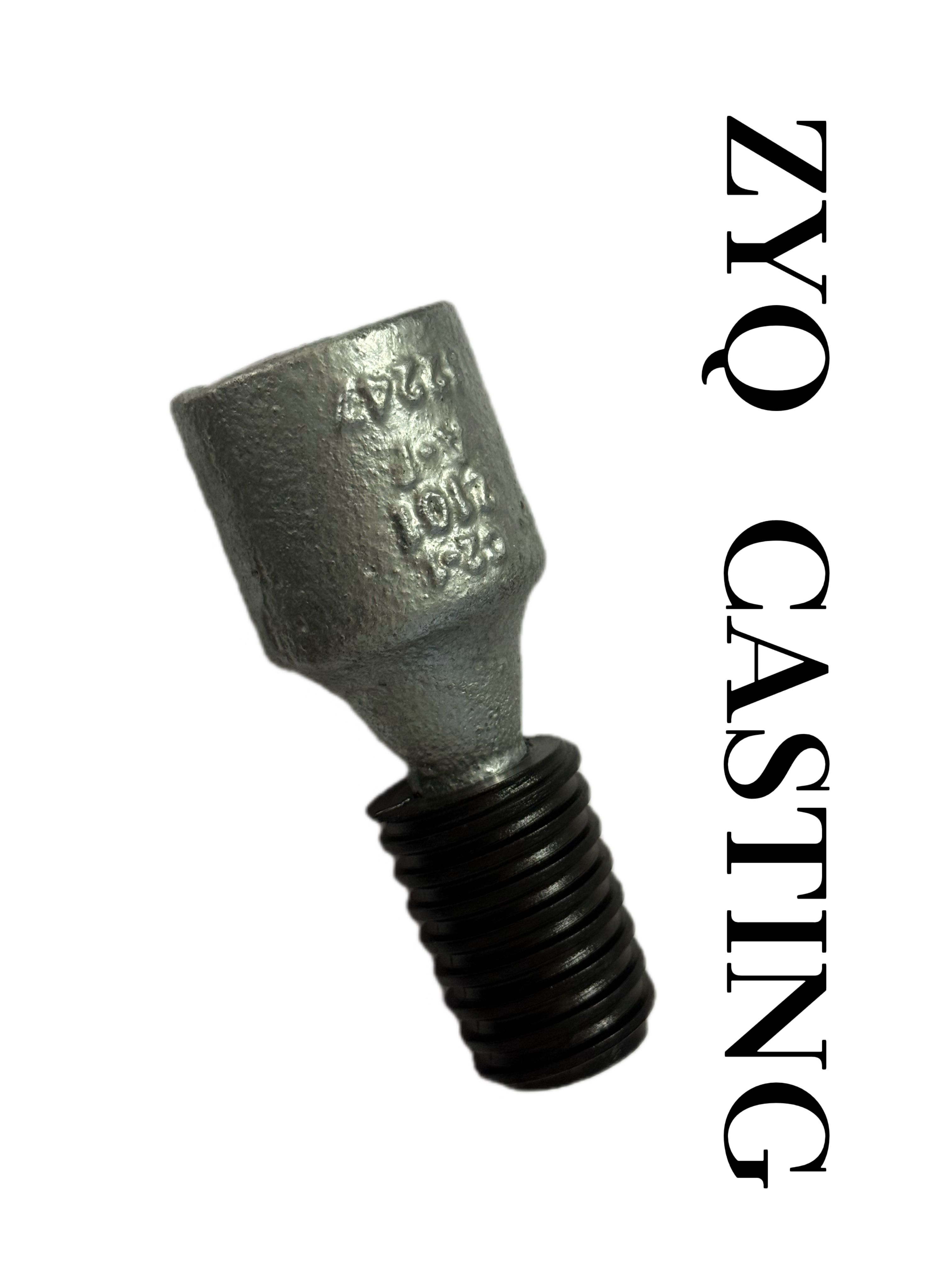
The edge comes down to metallurgical discipline. In the best Chinese foundries, the graphite nodules are small, round, and evenly distributed—a sign of tightly controlled inoculation and magnesium treatment. When the matrix is predominantly ferritic or pearlitic as specified, and the cooling rate after pouring is managed to avoid carbides, the resulting casting can match or exceed a forging's fatigue strength in cyclic loading applications. Forgings rely on directional grain flow, but ductile iron's isotropic properties often reduce stress concentration at section changes, which is why suspension brackets and axle housings increasingly use castings instead of forged blanks.
The gap between top-tier and average Chinese suppliers usually appears in three places: raw material consistency, melt treatment timing, and heat treatment precision. Shops that buy low-grade scrap or skip desulfurization before nodulizing produce vermicular or flake graphite pockets that act as crack initiators. Others pour too fast or too slow, creating shrinkage porosity in thick sections. A proper anneal or normalize can fix many sins, but only if the foundry holds the soak time and cooling rate within a narrow band—something poorly equipped plants often fail to document, let alone control.
Choosing a supplier means looking past the certificate. Ask to see cross-section micrographs from multiple heats, not just a polished sample. Request fatigue test data and impact values at low temperature, since these reveal hidden microporosity and graphite degeneration. A forging might still win in extreme toughness or high surface pressure applications, but for complex shapes with weight constraints, a well-made ductile iron casting from a disciplined Chinese foundry is often the smarter engineering choice—provided the buyer verifies process capability rather than trusting a price list.
The Hidden Cost of Cheap Pig Iron: Tramp Elements and Melt Quality
The appeal of low-cost pig iron is easy to understand; foundries watch margins closely and a cheaper charge material seems like a straightforward win. But that lower price often comes with higher residual levels of copper, tin, chromium, nickel, and molybdenum. These tramp elements do not simply disappear during melting—they accumulate in the metal and alter solidification behavior in ways that are difficult to predict from a standard chemistry report alone.
Copper and tin, for instance, concentrate at grain boundaries during solidification and can produce serious hot shortness or surface cracking in castings. Chromium and nickel shift the pearlite/ferrite balance and raise hardness, which may sound beneficial but often leads to machining difficulties, inconsistent microstructure, and increased scrap rates. The real cost shows up later: rejected castings, extra heat treatment, or customer complaints about poor machinability and dimensional instability.
Melt quality also suffers in less visible ways. Tramp elements can interfere with inoculation and nodularity in ductile iron, making the melt shop work harder to hit the same mechanical properties. When you factor in the added alloying corrections, longer cycle times, and quality risk, cheap pig iron frequently ends up being the more expensive option over a full production run.
Stress Relief Done Right: Avoiding Distortion and Residual Stress in Large Castings
Stress relief in large castings is often misunderstood as a simple post-casting step, but doing it right demands a balance between thermal uniformity and mechanical constraint. When a massive part cools unevenly, internal forces build up long before any visible crack appears. The problem isn’t just the peak temperature; it’s the rate of change across thick and thin sections. A proper cycle must allow the entire volume to reach a uniform soak temperature, typically 50–100°F below the lower critical transformation point, and hold it long enough for the grain structure to relax without entering the brittle zone. Rushing this stage or relying on a furnace thermocouple that doesn’t reflect the core thermal lag can leave locked-in stress that later causes distortion during machining.
Residual stress in large castings rarely announces itself until the first machining cut releases it. One common mistake is assuming that a visual inspection or a simple hardness check is enough to confirm stress relief. The reality is that stresses can hide in the as-cast surface while the interior remains in tension. To avoid this, foundries need to map thermal gradients during cooling, use multiple contact thermocouples at strategic depths, and record a time-temperature profile for every heat. For sections thicker than four inches, a step-down cooling rate—sometimes as slow as 50°F per hour until the part drops below 600°F—prevents new stress from forming even after the soak is complete. Skipping this controlled cooldown is the fastest way to turn a dimensionally sound casting into a warped reject.
Distortion in large castings is not a single event but a cumulative result of thermal history and restraint design. Even if the stress-relief cycle is perfect, the way a part is supported in the furnace can reintroduce bending moments. Large flat or ring-shaped castings need continuous support along their neutral axis, not just at three points. Using sand beds or contoured ceramic supports helps distribute weight evenly, preventing sag under the part’s own mass at elevated temperatures. Additionally, machining allowances should account for the fact that some movement will occur no matter how careful the process is. A well-designed casting leaves extra stock in high-constraint areas and uses stress-relief grooves or temporary webs that can be removed after the first rough cut. By treating stress relief as an integrated part of the casting design rather than a standalone fix, manufacturers can hold tight tolerances without relying on luck or repeated straightening operations.
From Excavator Booms to Wind Turbine Hubs: Matching Ductile Iron Grades to Real Loads
Excavator booms live in a world of relentless bending and shock. A 65-45-12 ductile iron often settles the argument here—its 12% elongation lets the boom shrug off a sudden rock strike without cracking, while the 45 ksi yield keeps the section from growing too heavy. On the casting floor, the goal is a mostly ferritic matrix with small, well-rounded graphite nodules; any pearlite banding near the pin bosses gets flagged because that's exactly where fatigue cracks start after a few thousand dig cycles.
Wind turbine hubs sit at the opposite end of the loading map. They twist under blade-root moments, get squeezed by pitch bearing bolts, and must survive sub-zero nights without a brittle failure. EN-GJS-400-18U-LT (or its ASTM cousin 60-40-18) is the workhorse here, not because it's the strongest, but because its guaranteed 18% elongation and low-temperature impact values hold up when the load path changes direction every three seconds for twenty years. For newer, larger rotors, some designers push into solution-strengthened ferritic grades or even austempered ductile iron where the hub flange meets the blade bearing, trading a bit of machinability for a higher fatigue limit.
The real skill is refusing the "stronger is better" habit. A 100-70-03 grade might look impressive on a data sheet, but in a boom or hub its pearlitic matrix turns every stress riser into a crack initiation site. Matching a ductile iron grade to a real load means reading the service history—does it see one massive overload or ten million small cycles? does the temperature swing matter more than the peak stress?—and then picking the grade whose graphite structure and matrix actually match that story, not just the highest tensile number in the catalog.
Beyond the Certificate: How to Audit a Chinese Foundry Without Flying There
Most buyers assume a certificate on the wall means quality on the line. In China, that assumption can cost you a container of scrap metal. The real audit starts with verifying who actually owns the factory you are talking to. Ask for the business license and cross-check the legal representative, registered address, and paid-in capital against third-party databases. If the registered capital is under 500,000 RMB and the address is a virtual office, you are likely dealing with a trading company that subleases production to a village workshop. No amount of ISO paperwork fixes that.
Next, demand a live video walkthrough with a timestamp. Do not accept a pre-recorded tour or a carefully framed corner of the workshop. Ask the person on the call to walk outside and show the street sign, then walk back in and pan across the entire floor. Watch for details: Are workers wearing proper PPE? Are raw materials stored off the ground? Is the CNC machine actually running or just dusted for show? A foundry that hesitates to show you the melt deck or the sand lab is hiding something. Legitimate operations will have a foreman who can answer technical questions on camera—if the camera only points at the office, hang up.
Finally, use a local third-party inspector who reports directly to you, not to the factory. Do not rely on the factory's recommended inspection agency. Commission an independent firm from Shanghai or Ningbo that specializes in foundry audits. Ask for raw photos, unedited videos, and a checklist that goes beyond dimensional checks: chemical composition of the melt, hardness testing, shrinkage cavity detection, and actual casting weight versus drawing weight. A good inspector will also check the scrap pile out back—if you see a mountain of rejected castings with your customer's logo on them, that tells you more than any certificate ever will.
FAQ
Ductile iron contains spherical graphite nodules, which let it bend and absorb stress without cracking the way gray iron's flake graphite does. That means parts can handle higher loads and sudden impacts while still being machinable.
It usually comes down to a combination of mature foundry clusters, competitive pricing on raw materials and labor, and experience with large production runs. Many Chinese foundries also invest in modern molding lines and spectrometers, so they can hold tight tolerances at scale.
Ask for a chemical analysis report, microstructure photos showing nodularity above 80%, hardness and tensile test results, and dimensional inspection data. A trustworthy supplier will also offer batch traceability and can handle third-party audits without hesitation.
Automotive suspension and steering components, pump housings, valve bodies, gearboxes, agricultural machinery, and construction equipment. The material's strength-to-weight ratio and fatigue resistance make it a practical choice for these demanding uses.
Work with a foundry that uses simulation software for gating and risering design, and request a casting process review before tooling begins. Also set clear acceptance criteria for surface quality and internal soundness, such as maximum allowable porosity levels on machined surfaces.
Yes, many foundries produce to ASTM A536, ISO 1083, EN 1563, or JIS G5502. You should still confirm which standard the supplier certifies against and request material test certificates for each shipment, not just a one-time qualification.
New tooling typically takes 4 to 8 weeks, with sample castings another 2 to 3 weeks after pattern approval. Production runs depend on complexity and quantity, but you can generally expect 30 to 60 days from order release to shipment. Costs hinge on pattern design, weight, machining requirements, and surface treatment.
Conclusion
The real difference between a Chinese ductile iron casting that lasts and one that fails rarely shows up on a certificate. Nodularity is the first place to look: graphite nodules need to be round, evenly distributed, and free from exploded or vermicular forms, because a drop from 90% to 70% nodularity can cut fatigue life by half. Foundries that consistently hit high nodularity treat the melt with precise magnesium control, avoid late inoculation errors, and refuse cheap pig iron loaded with tramp elements like lead, titanium, and antimony. These contaminants poison the graphite shape and create hard spots or shrinkage porosity that machining later exposes. When a Chinese foundry gets this right, its castings can outperform forgings in certain applications, especially where complex shapes and vibration damping matter more than raw tensile strength.
But microstructure is only part of the story. Large castings such as excavator booms and wind turbine hubs demand stress relief cycles that actually match section thickness and cooling rates, not a generic furnace recipe. Skipping or rushing this step leaves residual stress that can cause cracking during service or after final machining. Grade selection also needs to follow real load conditions: over-specifying a high-strength grade like EN-GJS-700 may reduce elongation and make the part brittle under impact, while a lower grade like EN-GJS-400 offers better fatigue performance in dynamic structures. To audit a foundry without flying there, ask for time-stamped melt logs, photomicrographs from the same heat, and residual stress test data from a recent large casting. A supplier willing to share that level of detail is usually one whose castings will hold up long after the paperwork is filed away.
Contact Us
Contact Person: Nico Yin
Email: [email protected]
Tel/WhatsApp: 8618561567088
Website: https://www.ductileironparts.com/