

China Magnet Wire: Key Trends and Applications in Modern Motor and Transformer Design
2026-11-26
Motors and transformers rarely fail because of one dramatic flaw. More often, the difference comes down to the winding wire—its insulation, consistency, and thermal behavior. As China’s magnet wire sector pushes into higher-efficiency designs, those details are becoming harder to ignore. In this post, we explore the key trends and application shifts shaping modern motor and transformer design, and how Huaying is positioned within that movement.
Why Motor Designers Are Revisiting Thermal Class Before Choosing Magnet Wire
Thermal class used to be selected once and then left alone, often inherited from a previous design without much thought. That is changing as windings get denser and inverters push more harmonic current through the same copper. The average winding temperature shown in a simulation can hide hot spots near slot liners or end turns that run 20°C to 30°C higher. Those local temperatures, not the nameplate class, determine how fast the enamel loses its dielectric strength. Motor designers are therefore revisiting thermal class before choosing magnet wire to make sure the rating reflects real hot spots rather than a convenient legacy value.
The ten-degree rule is blunt, but it still shapes decisions: insulation life tends to halve with every 10°C rise above the rated limit. In traction motors and high-speed spindles, harmonic heating, moisture, and automatic transmission fluid can attack the wire coating in ways that standard thermal endurance tests do not reproduce. A higher thermal class can buy margin against these combined stresses. Some teams are selecting a 200°C enamel not because the motor is expected to run at 200°C, but because it keeps the insulation farther from the edge when a transient overload pushes local temperatures up.
Cost rarely enters the discussion until procurement pushes back, yet the comparison is often too narrow. Higher-class magnet wire may cost more per kilogram, but it can allow a smaller cooling jacket, reduce the number of derating assumptions, or avoid expensive field failures in applications where service access is difficult. That changes the real system math. Designers who revisit thermal class early can decide whether the premium is cheaper than extra cooling or a larger frame, rather than treating it as a standalone material cost.
The Move from Round to Rectangular Conductors in EV Traction Motors
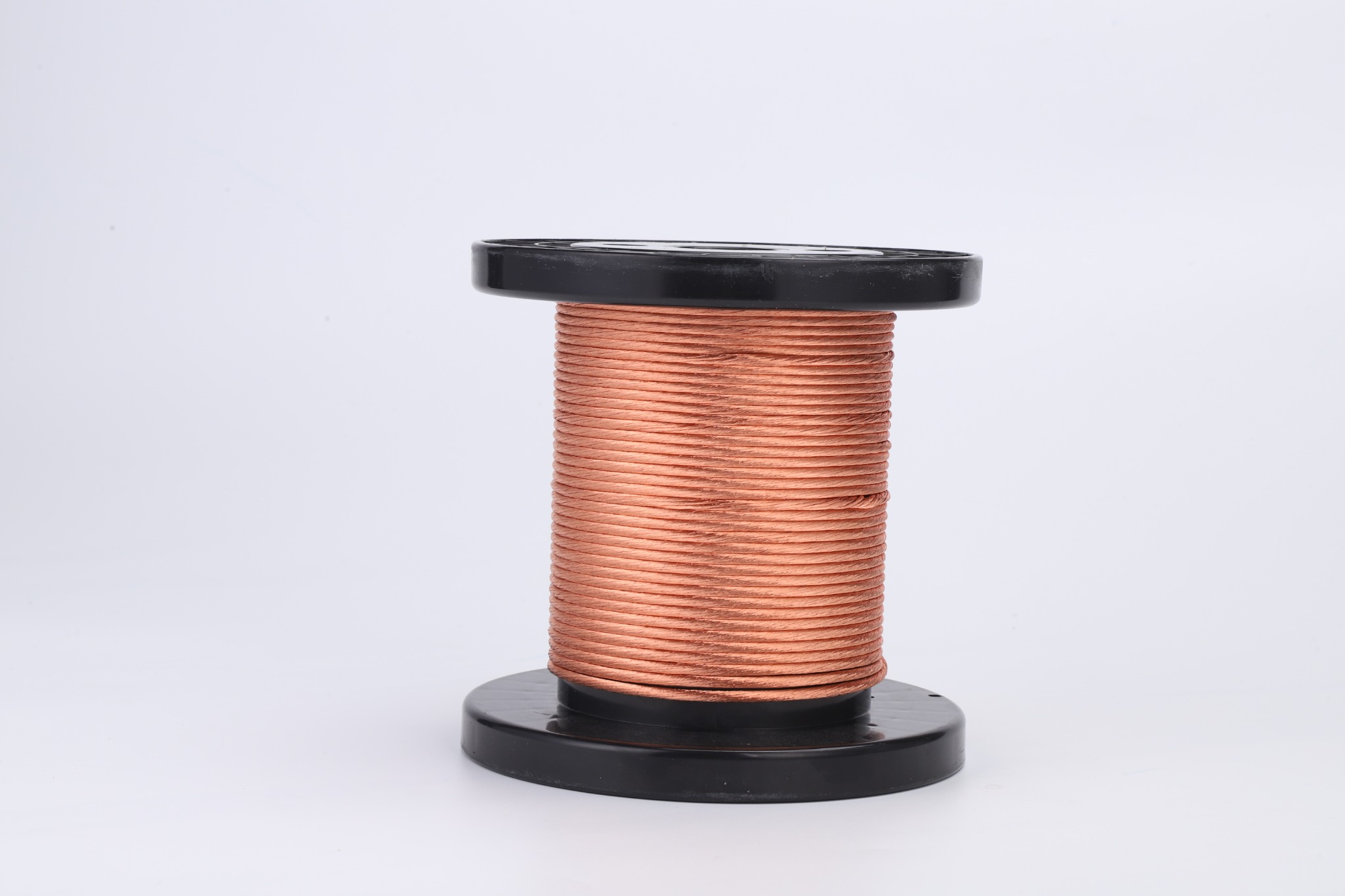
Round wire has been the default choice in traction motor windings for years, but it leaves a fair amount of empty space inside each stator slot. Switching to rectangular conductors changes the geometry completely: the flat sides nest against one another, pushing copper fill upward and giving the same slot cross-section more current-carrying material. That shift alone improves torque density without enlarging the motor envelope, which matters in a vehicle platform where space is already tight.
The benefits go beyond packing. Rectangular conductors shorten end-turn height because fewer, thicker bars replace many small strands, and the simpler shape reduces the messy overlap at the winding ends. Shorter end turns trim resistance and thermal hotspots, while the larger contact area between adjacent conductors helps pull heat out of the slot toward the cooling path. These effects compound as voltage and power levels climb, making the format especially useful for modern electric drive units that are asked to deliver more from the same package.
There are tradeoffs, of course. At higher speeds, skin and proximity effects become harder to ignore in solid rectangular sections, so designers may segment or transpose the conductor to keep AC losses in check. Manufacturing also shifts from flexible winding processes to hairpin forming, welding, and precise insertion, which puts new demands on tolerance control and quality inspection. Even so, the move is less about replacing round wire outright and more about matching the conductor architecture to the thermal, electrical, and packaging targets of the next generation of traction motors.
Transformer Efficiency Pressures and the Push for Better Conductor Fill
Stricter efficiency mandates and rising total cost of ownership have put transformer designers in a difficult spot. Every watt of load loss now carries more weight, yet the usual fixes—larger cores, more copper, extra cooling—run into material budgets and footprint constraints. That pressure has shifted attention toward conductor fill, the share of the core window actually occupied by conductive material rather than insulation, voids, or cooling channels. Improving that ratio is one of the few remaining levers that lowers I²R losses without adding bulk. In practice, even a few percentage points of higher fill can trim winding resistance enough to matter across a 20-year service life, especially in distribution units running near rated load for long stretches.
The push for better fill is forcing changes well beyond the winding specification. Rectangular and continuously transposed conductors are displacing round wire where the geometry allows, while thinner, higher-grade insulation films reduce the space sacrificed between turns. Some manufacturers now use vacuum pressure impregnation and controlled tension winding to pack conductors more tightly without risking voids or hot spots. The trade-offs are real: tighter fill leaves less room for oil flow and can complicate heat removal, so thermal modeling and resin selection become part of the same conversation. Still, the direction is clear. When efficiency targets tighten annually, the gap between a conventional winding and a well-packed one often decides whether a design meets its loss budget or misses it.
Aluminum Windings Get a Second Look as Copper Costs Fluctuate
Copper’s price swings have become erratic enough that engineers are revisiting assumptions they stopped questioning years ago. Aluminum windings, once pushed aside as a lower-performance compromise, are getting a second look in transformers, motors, and inductors where stable sourcing now matters as much as raw efficiency.
The shift is not just about cheaper metal. Aluminum weighs about one-third as much as copper and can be simpler to secure when lead times stretch. The old objections—lower conductivity, bulkier coils, finicky terminations—are still valid, but improved alloys and more precise winding methods have reduced those penalties. Teams are running pilot builds instead of ruling the material out from a spreadsheet.
The real change is in how the economics play out. When copper spikes, enlarging an aluminum conductor to carry the same current becomes less of a cost burden. If a design can absorb a modest size increase, the savings often cover the extra enclosure or core adjustments. That has moved aluminum from a fallback option to a deliberate engineering decision where predictable cost is part of the specification.
What Coating and Insulation Failures Reveal About Real-World Motor Life
Field tear-downs rarely match the neat degradation curves plotted in laboratory life tests. When a motor comes back with scorched slot liners, flaking varnish, or insulation that crumbles at a touch, the story is seldom just about thermal aging. It often points to a cascade of small operational insults—voltage spikes from long cable runs, moisture creeping through breather gaps, or abrasive particles packing into end windings. These real-world signatures indicate that insulation life is not a fixed number of hours; it bends sharply with how consistently the operating environment stays within the motor's assumed envelope.
Coating failures tend to expose the same blind spots. A corroded frame or peeling conformal coating is not merely cosmetic. It usually signals that the enclosure rating, drainage design, or maintenance rhythm was mismatched to the actual plant conditions. Once the protective film breaks down, moisture and contaminants find a direct path into winding insulation and bearing housings. The result is a shortened interval between rewinds, not because the copper or steel wore out, but because the outermost barriers quietly gave up first.
Reading these failure surfaces as evidence rather than isolated damage changes how maintenance teams set replacement budgets. Instead of trusting a generic insulation class temperature limit, they begin tracking transient events, condensation cycles, and airborne dust loads. In many facilities, the motors that fail early share a few telling marks: cracked tie-coat around the stator slots, charred winding tape near the leads, or rust bleeding through frame joints. Those marks are a more reliable predictor of remaining service life than any nameplate rating or default industry estimate.
Faster Winding Lines Are Redefining Magnet Wire Tolerance and Finish
Running a winding line at higher speed used to mean accepting more scrap and occasional coil rejects. That trade-off no longer holds. Wire diameter now has to stay within a few microns across an entire spool because any short-lived ovality or periodic diameter drift gets amplified the moment tension rises. Winding shops are pushing for tighter dimensional reports, and suppliers who cannot hold those bands simply get filtered out.
Finish requirements have shifted just as sharply. At speed, the enamel or self-bonding layer sees more frictional heat before the wire ever reaches the forming point. A slightly uneven coat that would have passed years ago now causes turns to sit differently, pack less copper into the slot, or transfer heat unevenly. The practical answer has been a move toward thinner, harder lubricant films and coatings that survive high-rate pay-off without building up residue on guides and pulleys.
The real consequence is that tolerance and finish are no longer inspected after the fact; they are designed around the winding process itself. Wire makers are adjusting drawing, annealing, and coating steps with specific line speeds in mind, while winding equipment builders assume a much narrower input window. The two sides now tune parameters together, which is why the old split between “wire quality” and “machine capability” is fading.
FAQ
Motor and transformer designers keep pushing for smaller frames and higher efficiency, so the insulation has to survive hotter operating conditions. Chinese producers have responded by expanding capacity for class 200 and 220 enameled wire, often using modified polyester or polyesterimide topcoats that hold up better under thermal stress.
Rectangular or flat wire allows much higher slot fill than round conductors, which directly improves torque density and reduces copper loss. In China, the adoption has moved from large industrial motors and EV traction motors into smaller auxiliary drives as manufacturing precision has improved and costs have come down.
With wide-bandgap semiconductors becoming more common, motors see faster switching and sharper voltage spikes. That puts extra stress on turn-to-turn insulation. Chinese magnet wire suppliers now offer inverter-rated products with improved enamel formulations and higher partial discharge inception voltage to handle those conditions without premature failure.
Aluminum magnet wire is used mainly where weight and material cost matter more than absolute conductivity, such as in distribution transformers and some appliance motors. Chinese manufacturers have improved the surface treatment and jointing techniques for aluminum conductors, helping address the oxidation and termination concerns that used to limit adoption.
Many plants are moving away from solvent-heavy enamel processes toward low-VOC or water-based insulation systems, and they are paying closer attention to energy use during annealing and curing. At the same time, they are developing wire with higher temperature ratings so customers can use less copper without sacrificing reliability.
It depends less on the country and more on the specific mill. Buyers should look at consistency of enamel concentricity, adhesion and flexibility after thermal aging, and whether the supplier can provide full traceability for the copper rod and insulation batch. Some Chinese mills now run highly automated inline inspection, while others still rely on sampling, so qualification testing matters.
EV traction motors, high-efficiency compressors, wind turbine generators, and energy storage inverters are among the strongest demand drivers. These applications require tight dimensional tolerances, high thermal class, and reliable performance under high-frequency inverter operation, so they tend to use premium grades rather than commodity wire.
Hairpin windings use rectangular conductors that are cut, formed, and welded, so the wire needs consistent dimensions, good bendability without insulation cracking, and clean stripping behavior at the joint. Chinese suppliers have had to tighten tolerance control and adjust enamel properties specifically for this process, since traditional round-wire tests do not fully predict hairpin performance.
Conclusion
Magnet wire decisions in China now carry far more weight than they did a decade ago, partly because thermal class is back on the table during the earliest stages of motor design. Engineers are no longer treating enamel ratings as a simple spec checkbox; they are comparing actual hot-spot behavior, overload cycles, and voltage stress before locking in a conductor. In EV traction motors, that scrutiny has accelerated the switch from conventional round wire to precision-formed rectangular conductors, which allow tighter slot packing and better heat dissipation. The same pressure appears in transformer design, where efficiency targets keep climbing and every small gain in conductor fill translates into lower load losses. Against that backdrop, aluminum windings are being reconsidered not as a downgrade but as a practical hedge when copper prices swing sharply, especially in applications where weight and cost matter more than ultimate conductivity.
Field experience with insulation and coating failures is also reshaping expectations. Rather than treating breakdowns as rare manufacturing defects, many Chinese suppliers and OEMs now read them as evidence of how motors actually age under partial discharge, moisture, and thermal cycling. That has led to tougher incoming inspection and a much closer look at film adhesion and pinhole density. At the same time, faster winding lines are pushing magnet wire tolerances and surface finish into new territory. Wire that works at moderate line speeds can develop springback, inconsistent layering, or friction problems when equipment accelerates, so suppliers are adjusting drawing and annealing procedures to maintain stable dimensions. Together, these shifts reflect a more integrated approach: material choice, insulation system, conductor geometry, and production speed are being evaluated as one system rather than separate purchasing decisions.
Contact Us
Contact Person: Mr. Zou
Email: [email protected]
Tel/WhatsApp: 8613929536496
Website: https://www.huayingwire.com