

High Titanium White Masterbatch Supplier for Exceptional Brightness and Opacity
2026-08-26
When it comes to achieving exceptional brightness and opacity in plastics, the choice of white masterbatch supplier makes all the difference. Xinwancai has built a reputation around high titanium white masterbatch that delivers clean, brilliant whites without compromising processability. In this post, we explore what sets their formulations apart and why they are a go-to for manufacturers who demand consistent color performance.
Not All White Masterbatches Are Created Equal
A lot of processors assume any white masterbatch will do the job, but that assumption falls apart the moment you look at opacity, tint strength, and how the concentrate behaves in your specific resin system. The difference usually starts with the titanium dioxide grade—some suppliers use a pigment with a coarser particle size or a less effective surface treatment, which leaves you needing higher let-down ratios just to hit the same hiding power.
Carrier resin compatibility is another silent variable. A masterbatch built on a generic polyolefin carrier might blend fine in polyethylene but cause surface defects, die lines, or reduced mechanical properties in polypropylene or engineering resins. The better formulations are tailored to the base polymer, so the pigment disperses evenly instead of forming agglomerates that show up as specks or streaks in thin film or injection molded parts.
Then there's the impact on downstream performance. A cheap white can drift in color during long runs, leave plate-out on molds, or break down under high heat, shifting the final part's appearance and even its UV stability. When you account for scrap rates, line downtime, and customer complaints, the true cost of a lower-grade white masterbatch rarely stays on the invoice.
The Science Behind High Opacity Without Extra Cost
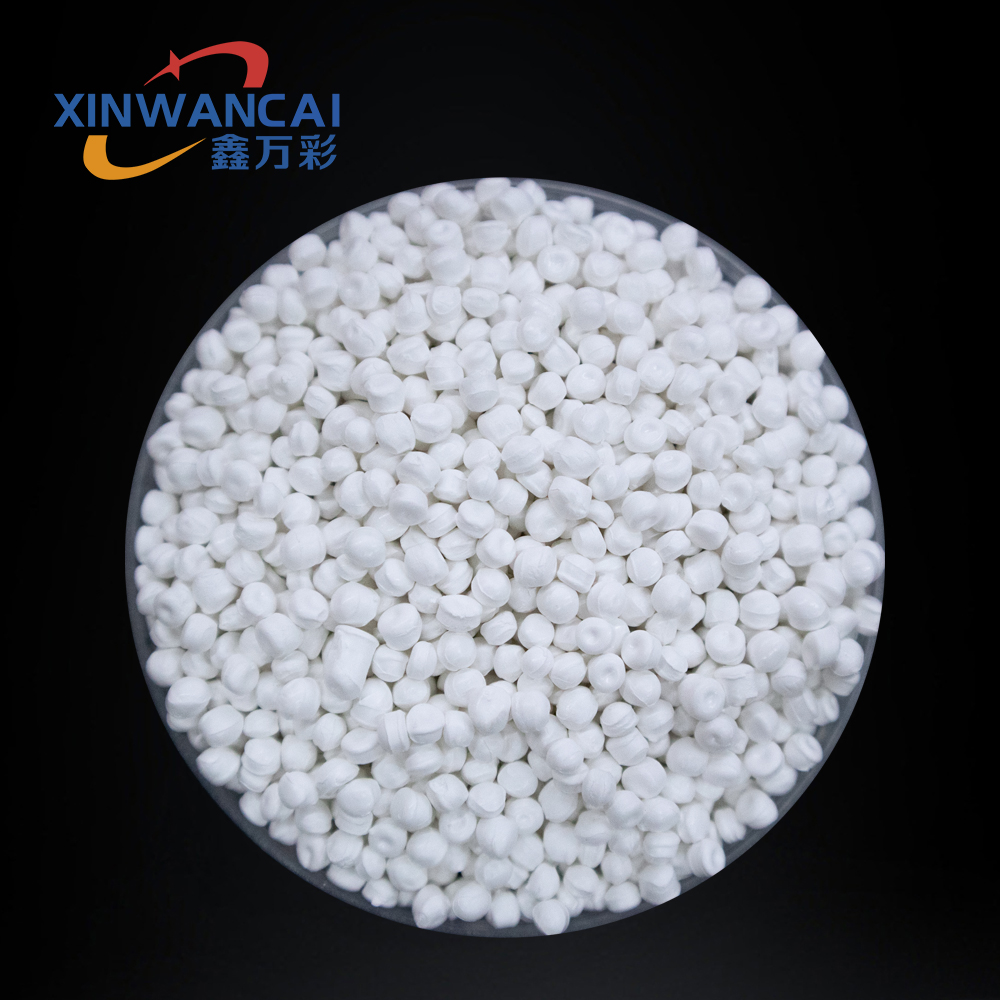
Most people assume that achieving rich, buildable coverage means using more pigment, but opacity is less about quantity and more about how well particles scatter light. Titanium dioxide, for instance, delivers high hiding power at relatively low loadings because its refractive index bends light sharply away from the surface. Formulators can tune particle size and surface treatments to maximize that scattering without piling on extra raw material.
The real cost saving comes from improved dispersion and spacing. When pigment clumps together, light bypasses the gaps and the coating looks thin or patchy, forcing you to add more product. By using dispersants and controlled milling, manufacturers keep particles evenly separated at the micron level. This lets a smaller amount of pigment cover the same area with uniform opacity, reducing both material waste and production expense.
Why Dispersion Quality Changes Everything
Dispersion quality is rarely the first thing people check when a formulation fails, but it's often the actual culprit. A pigment or filler that isn't fully separated into its primary particles will behave like a different material altogether. You get lower color strength, uneven gloss, and a viscosity that drifts batch to batch. Even a small percentage of agglomerates can act as stress concentrators in a cured film, leading to micro-cracks or premature failure. The particles that stay clumped together don't contribute their intended surface area, so the same amount of raw material delivers far less performance.
At the production level, poor dispersion translates directly into wasted time and money. Grinding or milling cycles have to be extended, more dispersant is consumed, and the end product still needs constant rework. A well-dispersed system, by contrast, stabilizes quickly and holds its properties through storage, pumping, and application. That consistency is what allows a coating to spray without clogging, an ink to print clean edges, or a cosmetic to spread with a smooth, even texture. The difference isn't just in the lab data—it's in whether the product performs the same way on a humid Monday as it did on a dry Friday.
Matching Grades to Your Exact Polymer System
Grade selection rarely hinges on a single property like melt flow or tensile strength. A polymer that performs brilliantly in a thin-wall injection molding setup may fail under the slower thermal cycles of rotational molding, even if the base resin looks identical on paper. Start by mapping your system's actual shear rates, cooling profile, and residence time before narrowing down candidate grades. This avoids the common trap of over-specifying a premium grade that brings no processing advantage.
Next, look beyond the standard datasheet. Molecular weight distribution, comonomer content, and additive packages often matter more than nominal density or modulus. For wet or chemically aggressive environments, a grade with a slightly lower mechanical rating but superior hydrolysis resistance may outlast a stronger-looking alternative. Ask your supplier for lot-to-lot consistency data and real-world failure examples from similar systems, not just lab benchmarks.
Finally, prototype with the exact grade under your own tooling and downstream conditions. Small shifts in nucleating agents or processing aids can change warpage, surface finish, and weld line strength in ways that generic simulation tools miss. Keeping two or three adjacent grades on hand during validation gives you room to adjust without restarting the entire qualification process.
Real-World Proof: Where Brightness Really Counts
Forget the spec sheet for a minute and picture a Saturday afternoon with friends over. The blinds are open because nobody wants to sit in a cave, and someone puts on a live match. Most projectors would turn the screen into a washed-out ghost, but a high-brightness model keeps the greens of the pitch and the white jerseys looking solid. That moment, when the room is flooded with daylight and the picture still holds its own, says more than any lumen rating in a lab.
Take it outside on a summer evening and the difference gets even starker. String lights are glowing over the patio, maybe a neighbor's porch light spills across the fence, and you're projecting onto a sheet hung from the garage. With enough real brightness, the movie doesn't dissolve into a pale rectangle; faces stay readable and night scenes still have depth. It's the kind of casual, no-fuss setup that makes people ask what projector you're using, because it just works where others fail.
Then there's the conference room with floor-to-ceiling windows at high noon. The sun is cutting across the whiteboard, and someone dims the lights out of habit. A bright projector changes that routine. Charts stay crisp, text doesn't blur into the background, and everyone can keep their laptops open without squinting through gloom. That's where brightness stops being a number and starts changing how people actually use the space.
Supplier Consistency You Can Measure, Not Just Claim
A supplier's consistency shows up in the spread of your incoming inspection data, not in their brochure. Track the same five critical parameters across twenty consecutive shipments and plot them on a control chart. If the mean stays within spec but the range widens every third batch, you have a hidden process drift that a simple pass/fail audit will never catch.
Require your suppliers to report capability indices like Cpk and Ppk for the exact lot numbers they ship to you, then verify those numbers with your own blind measurements. The gap between a supplier's self-reported sigma level and your independently calculated repeatability is the true cost of their inconsistency. When that gap exceeds 0.3 on a Cp scale, negotiate corrective action tied to payment terms, not promises.
Shift your vendor scorecard from average delivery time to on-time-in-full percentage plus a variance penalty. Two suppliers can both deliver in 14 days on average, but one hits days 13, 14, 15 while the other swings between 7 and 21. The second supplier's erratic lead time forces you to hold safety stock and reschedule production. Measure the range, not just the mean, and you stop rewarding lucky averages.
FAQ
Check the titanium dioxide grade and loading percentage—typically 60% to 80%—along with the carrier resin. A supplier that uses rutile TiO₂ with a tight particle size distribution will deliver cleaner whites without the yellowish undertone you sometimes see in lower-cost batches.
Higher TiO₂ loading creates more scattering points for light, so even films below 30 microns can block what's behind them. The key is good dispersion; if the pigment clumps, you'll lose both opacity and surface smoothness.
A specialist usually has finer control over melt filtration and twin-screw parameters, which matters because TiO₂ is abrasive. They're more likely to toll-process with higher mesh screens and maintain consistent letdown ratios, so you don't get surprises between production runs.
Yes, as long as the carrier resin matches your base polymer. Many suppliers offer universal carriers for polyolefins, but for styrenics or engineering resins you'll want a compatible carrier to avoid delamination or loss of impact strength.
Keep melt temperatures below 240°C for most polyolefin-based masterbatches. Prolonged residence time at high heat can degrade both the carrier and any processing aids, which shows up as a cream or yellow cast rather than a bright white.
It tends to increase stiffness and slightly reduce elongation at break. For applications like rigid packaging or appliance housings this is usually fine, but for flexible films you may want to balance the letdown ratio to keep tear strength acceptable.
Ask for melt flow index, TiO₂ content by ash test, and a dispersion check using a microscope or pressure rise test. A trustworthy supplier will also give you lot-to-lot color data so you can match your existing color standards without reworking.
Conclusion
White masterbatches often look identical in pellet form, yet their performance diverges sharply once processed. The difference starts with titanium dioxide selection: a high-quality rutile grade with tight particle size distribution creates far more hiding power per gram than cheaper alternatives. But loading alone is not enough. The carrier resin must match the end polymer—polyethylene, polypropylene, or engineering resins each demand different melt flow and compatibility. A supplier that understands these nuances can deliver exceptional brightness and opacity without pushing dosage to cost-prohibitive levels. Poorly matched grades lead to surface defects, reduced mechanical properties, and uneven color, forcing converters to compensate with extra material.
Dispersion quality separates premium masterbatch from commodity products. TiO2 particles naturally agglomerate; if not fully broken down, they act like tiny gray specks that scatter light poorly and weaken film or molded parts. Advanced compounding with high-shear mixing and specialized wetting agents ensures every particle is wetted and distributed uniformly. This directly improves opacity per unit of pigment, allowing lower letdown ratios. The proof appears in thin-gauge packaging where a bright, uniform white sells the product, or in durable goods that must maintain color after years of use. A consistent supplier measures not just titanium content but also filter pressure rise, melt flow stability, and optical properties on every batch—so the brightness you approve in the lab is the brightness you receive on the production floor.
Contact Us
Contact Person: JACK
Email: [email protected]
Tel/WhatsApp: 86 18650130917
Website: https://www.xinwancai.com/