

Low-Dew-Point Wheel Desiccant Dehumidifier Unit Custom Built for Industrial Dry Air Applications
2026-10-28
Industrial dry air isn't just about removing moisture—it's about hitting and holding a low dew point without wasting energy. Most dehumidifiers aren't built for that level of control. That's why a custom-built wheel desiccant dehumidifier unit from ROTER can be a game-changer for plants dealing with sensitive materials or strict humidity specs. In the sections ahead, we'll unpack what goes into these tailored systems and how they solve problems that generic equipment simply can't.
What Actually Happens Inside a Low-Dew-Point Desiccant Wheel?
Inside a low-dew-point desiccant wheel, the rotor slowly turns through two sealed airstreams. On the process side, humid air passes across a honeycomb matrix coated with a high-performance desiccant such as silica gel or a molecular sieve blend. Water vapor is physically adsorbed into the pores of the desiccant, not condensed as liquid. Because the wheel rotates continuously, each section spends only a few seconds in the air stream before moving into the regeneration zone. This short exposure time, combined with the desiccant’s high affinity for moisture at low relative humidity, is what allows the leaving air to reach dew points well below freezing.
What sets low-dew-point operation apart is the regeneration sequence. A portion of the already dried air is often diverted through a purge sector first to cool the hot desiccant after regeneration, then blended with outside air and heated to 100–140°C before being pushed through the wheel in the opposite direction. This counterflow releases the captured water and carries it away as warm, moist exhaust. Without this purge step, residual heat would re-enter the process air and raise the effective dew point. The purge-to-process airflow ratio is carefully tuned so that the wheel spends just enough time in each zone to maintain a stable moisture adsorption front near the leaving edge of the rotor.
For extremely low dew points, the wheel is often built with a thicker desiccant layer on the process side and a smaller regeneration sector. This geometry forces the air to travel a longer adsorption path, allowing the final portion of the desiccant to remain nearly dry before it leaves the process zone. As a result, the dry air exits with a vapor pressure lower than what a single-stage cooling coil could ever achieve. The internal humidity profile across the wheel is not uniform—it behaves more like a moving bed adsorber, with a steep moisture gradient from the humid inlet to the bone-dry outlet.
Custom Builds That Match Your Plant's Airflow and Footprint
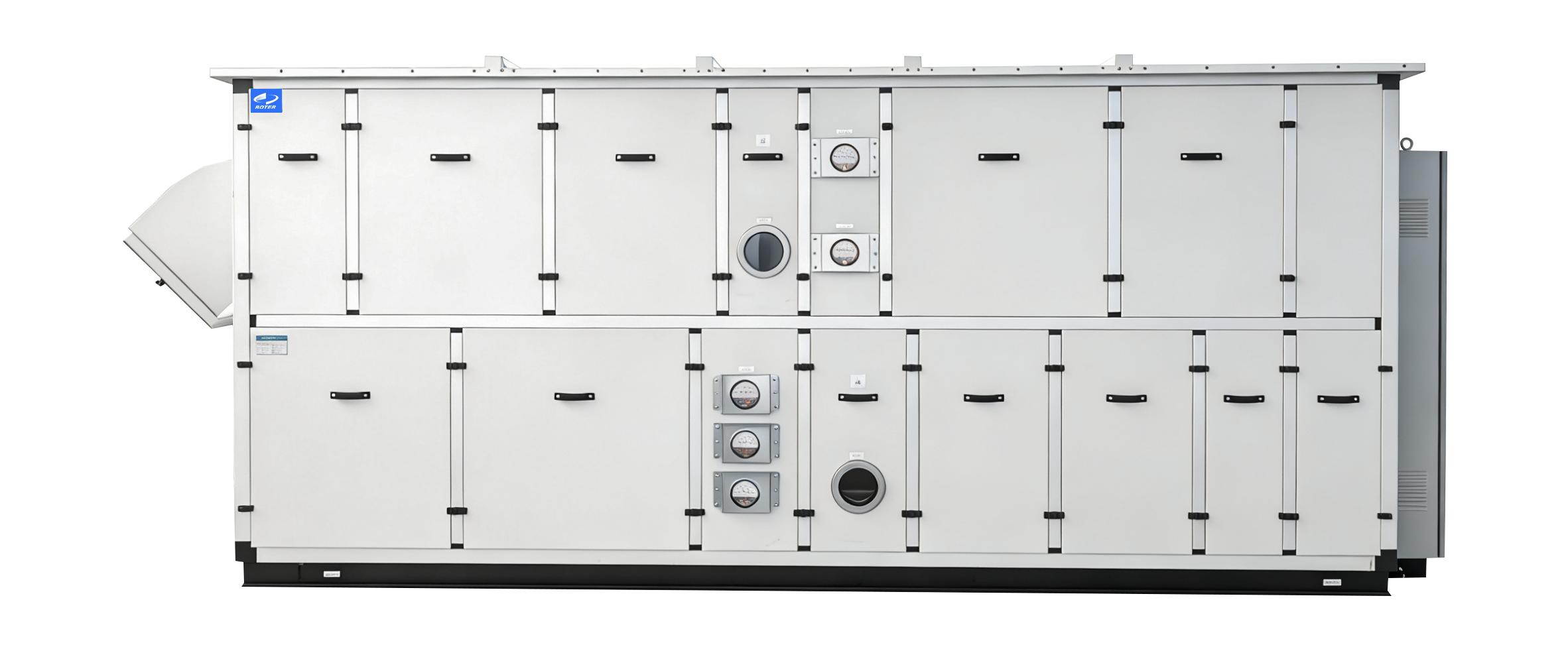
Your plant's ductwork, column spacing, and access routes rarely match a catalog drawing. Instead of padding the footprint with adapters or relocating structural steel, we use the actual aisle widths and clearance heights from your floor to shape the unit. The fan or blower ends up where it makes sense for your crew, not where a standard frame happens to fit.
Airflow behavior changes when a unit is squeezed into a corner or placed near an existing drop. We review the inlet and outlet conditions along with your static pressure requirements, then adjust the scroll orientation, discharge angle, or base footprint so the air path stays short and straight. Fewer elbows and transitions mean less energy lost to turbulence and easier duct connections during startup.
That approach also keeps maintenance realistic. Access doors, drain locations, and bearing points are positioned with the actual service clearance in mind, so technicians aren't reaching behind piping or working from a ladder in a narrow aisle. The build follows the constraints of your plant, and the result is a unit that fits the first time without field rework.
Moisture Control for Corrosion-Sensitive Industrial Spaces
Corrosion in industrial settings rarely announces itself until a flange fails or a control cabinet starts throwing intermittent faults. The driver is almost always airborne moisture interacting with surface contaminants, especially chlorides and sulfates that settle on metal during routine operations. Keeping relative humidity below 50% slows the electrochemical reactions enough to matter, but that threshold is not universal: zinc-coated steel tolerates a bit more, while machined carbon steel near salt spray can start pitting at 40% RH if the surface is already dirty. What often gets overlooked is the difference between absolute and relative readings. A cool corner that reads 45% RH in the morning can spike to 70% when the space heats up and air moves, because moisture stored in concrete or insulation gets released. So controlling bulk air is only half the job.
Desiccant dehumidifiers tend to outperform refrigerant-based units in these environments, not because they remove more water per kilowatt, but because they keep working at low temperatures without freezing coils or cycling off. That matters in unheated warehouses, pump rooms, and offshore modules where ambient temperature swings are wide. Pairing a desiccant rotor with a small post-cooler gives you dry air at a stable dew point without overcooling the space. But equipment alone won't fix a leaky building envelope. If outdoor air infiltrates through roller doors, cable penetrations, or roof vents faster than the dehumidifier can condition it, the moisture load becomes a moving target. A better approach is to slightly pressurize the protected area with dried air, so that every crack exhales instead of inhales. This also keeps humid, salt-laden air away from electrical enclosures and spare parts storage.
Monitoring should be tied to dew point rather than RH alone, because the metal temperature often lags the air temperature. A cold pipe in a room at 55% RH may still sweat if its surface sits below the dew point. Putting a few low-cost temperature/humidity loggers near the coldest surfaces—not in the middle of the room—gives a much clearer picture of actual corrosion risk. For critical areas like turbine halls or sensor calibration labs, aim for a dew point of -5°C to -10°C, which translates to roughly 20-30% RH at 20°C and leaves a safe margin against daily fluctuations. And when the process itself generates moisture, such as washdowns or steam leaks, address the source before adding more drying capacity. Otherwise you end up spending energy fighting a puddle that could have been mopped up in ten minutes.
Energy Draw Comparisons Between Desiccant and Cooling-Based Dryers
When evaluating energy draw, desiccant dryers typically consume more power per unit of dried air than cooling-based dryers, primarily due to the regeneration cycle required to purge moisture from the desiccant bed. A standard heatless desiccant dryer can use up to 15-20% of its rated airflow as purge air, which directly translates into higher compressor energy consumption. In contrast, refrigerated dryers operate by cooling the air to condense moisture, drawing a relatively steady electrical load that scales linearly with inlet temperature and flow, but without the purge air penalty.
The gap widens further in partial-load conditions. Cooling-based dryers often cycle their refrigeration compressor on and off or modulate capacity, reducing average power draw when demand drops. Many desiccant dryers, especially fixed-cycle models, continue to regenerate on a timer regardless of actual moisture load, wasting energy during low-flow periods. Even energy-saving dew-point-controlled desiccant dryers still face the inherent thermal and pressure losses of adsorbent regeneration, making them less efficient than refrigerated dryers for applications above the freezing point of water.
That said, the comparison shifts when the required pressure dew point falls below 35°F (2°C). Cooling-based dryers cannot achieve such low dew points without risking ice formation, so desiccant dryers become the only practical choice despite higher energy draw. In those scenarios, selecting a heated purge or blower-purge desiccant dryer can cut energy use by 30-50% compared to heatless designs, though total energy draw still generally exceeds that of a refrigerated dryer operating at a 38°F dew point. Thus, the energy comparison is only meaningful when both dryer types are capable of meeting the same outlet specification.
The Real Cost of Uncontrolled Humidity in Dry Air Operations
Many operators treat humidity as a minor inconvenience, but in dry air systems the financial damage shows up in places you might not expect. Moisture seeps into compressed air lines, corrodes valves, and shortens the life of pneumatic tools, while the repair invoices pile up quietly. Uncontrolled moisture also undermines the very purpose of a dry air process: if air isn't dry enough, sensitive equipment like instrumentation or food packaging lines suffers, leading to rejected batches or premature wear.
Energy bills creep upward as well. When humidity slips past controls, dryers have to work harder, refrigeration circuits run longer, and desiccant beds regenerate more frequently. This isn't just an equipment issue—it's a continuous operating cost. A facility could be spending thousands extra every month simply because moisture levels fluctuate beyond setpoints.
There's also the hidden price of downtime. A corroded valve that fails on a night shift, a blocked filter that starves an actuator, or mold growth in ductwork can stop a line for hours. These events rarely get attributed to humidity at first glance; they show up as "unplanned maintenance" or "quality hold." The real cost is not just the repair bill but the lost production and the erosion of confidence in your dry air supply.
Maintenance Routines That Keep Dew Point Low Year After Year
A consistent check on compressed air dryers is the first line of defense. Many facilities wait until moisture appears in the lines, but by then the dew point has already drifted. Instead, make it routine to test the dew point at the point of use and at the dryer outlet. This simple difference reveals whether the dryer is doing its job or if the piping is introducing moisture. Record the values weekly, not monthly, and compare them against the baseline from commissioning. Any upward trend, even a few degrees, often signals a clogged filter, a failing desiccant, or an undersized dryer being pushed beyond its rating.
Desiccant beds and refrigerant coils both lose efficiency through neglect. For desiccant dryers, scheduled replacement of the media before it saturates is non-negotiable—guessing by time alone invites trouble. Watch for pressure drops across the dryer, as a rising differential points to crushed or oil-fouled desiccant. For refrigerated dryers, keep the condenser fins clean and verify the dew point setpoint against the actual load. A coil that runs too cold can freeze moisture inside and then release slugs of water when it thaws, creating spikes that damage downstream equipment.
Drainage and ambient conditions often get overlooked. Automatic drains should be inspected monthly, not just when puddles appear under the tank. A stuck float or clogged orifice lets condensate re-enter the air stream, undoing all the dryer’s work. Equally important is the room where the compressor and dryer sit. High ambient temperatures force the dryer to work harder, and inadequate ventilation can push the inlet air temperature beyond the dryer’s design limit. Installing a simple temperature recorder near the dryer intake can reveal patterns—such as afternoon heat from a west-facing wall—that quietly raise the dew point year after year.
FAQ
It pulls moisture out of the air by passing it through a slowly rotating wheel coated with a desiccant material. As the wheel turns, one section adsorbs water vapor from the process air while another section gets heated to release that moisture into a separate exhaust stream. This continuous cycle lets the unit reach dew points well below freezing, which refrigerant-based systems can't achieve.
It means the unit is sized and configured around a specific facility's air volume, ambient conditions, and target humidity level. The casing materials, wheel diameter, regeneration heat source, fan arrangement, and control logic can all be adjusted. That way you don't pay for capacity you don't need or end up with a unit that struggles in a harsh environment.
Pharmaceutical production, lithium battery manufacturing, food processing, cold storage, and corrosion-sensitive electronics assembly are common examples. Any process where condensation, mold growth, or chemical reactions caused by moisture can ruin a batch or damage equipment tends to benefit from a low-dew-point wheel system.
Refrigerant units cool air to condense water, but they lose effectiveness below about 50°F dew point and can ice up. A desiccant wheel physically adsorbs moisture, so it keeps working at very low temperatures and can hit dew points of -40°F or lower. That's essential when a process demands truly dry air rather than just comfortable humidity levels.
Yes, most are designed for 24/7 operation with heavy-duty bearings, corrosion-resistant housings, and controls that can adjust the regeneration temperature based on load. The key is specifying the right components during the custom design phase—things like epoxy-coated wheels or stainless steel cassettes make a big difference in longevity.
Heat source flexibility is a big one: electric, steam, natural gas, or waste heat can regenerate the wheel. Controls can range from simple relay logic to full PLC integration with remote monitoring. Air filtration, pre-cooling or post-cooling coils, and special coatings for corrosive environments are other common add-ons.
Start with the required airflow, the lowest ambient moisture load you expect, and the target dew point. Then account for any internal moisture sources like open tanks or product drying. A proper design review will also consider duct static pressure, available utilities, and future expansion. That data drives the wheel diameter, regeneration heater size, and fan selection.
Conclusion
Inside a low-dew-point desiccant wheel, air passes through a slowly rotating matrix coated with a moisture-adsorbing material. Rather than simply cooling air to condense water, the wheel strips vapor out of the airstream at a molecular level, then a separate regeneration loop heats a small portion of the wheel to drive that captured moisture away. This lets the unit hold dew points far below what cooling-based dryers can manage. Custom builds matter because every industrial space has its own airflow pattern and floor constraints. A unit can be configured with a specific face velocity, wheel diameter, and casing layout so it slips into an existing mechanical room without forcing major ductwork changes. That kind of fit is often what makes the difference in corrosion-sensitive areas like battery dry rooms, pharmaceutical packaging lines, or precision metal storage, where even small moisture swings can cause oxidation, delamination, or product rejects.
Comparing energy draw, a desiccant wheel uses thermal input for regeneration but avoids the inefficiency of overcooling and reheating air that a cooling-based dryer must do. In many low-dew-point applications, the desiccant approach actually becomes less energy-hungry per kilogram of water removed once target dew points go below about 5°C. The real cost of uncontrolled humidity shows up as scrap, unplanned downtime, and surface rust, not just a higher utility bill. Keeping a unit at peak performance means sticking to a few non-negotiable maintenance routines: checking wheel seals for bypass leakage, replacing or cleaning filters on schedule, verifying regeneration heater output, and calibrating dew-point sensors at least twice a year. These steps keep the wheel's adsorption capacity stable, so the system holds low dew point year after year without drifting into the danger zone.
Contact Us
Contact Person: Rhea
Email: [email protected]
Tel/WhatsApp: +8618800560886
Website: https://www.rotorairtech.com