

PTFE Tube and Rod Solutions for Demanding Chemical and High-Temperature Applications
2026-11-16
Few materials survive where aggressive chemicals meet sustained heat, but PTFE continues to prove why it belongs in the most unforgiving process environments. From sealing systems that resist deformation to structural tubes that hold their shape under thermal cycling, the right geometry makes all the difference. In this post, we look at practical tube and rod solutions built for exactly these conditions — and why engineers increasingly turn to TAIFNO when standard fluoropolymer stock simply isn’t enough.
When Aggressive Chemicals Are the Everyday Feedstock
A plant manager once joked that if a material doesn't eat through a cheaper alloy by Tuesday, the procurement team hasn't found the real price point yet. That dark humor captures a working reality: hydrochloric acid, sodium hydroxide, and chlorinated solvents aren't special-case hazards in many facilities. They arrive by tanker, sit in storage, and flow through pipes on the same schedule as any other raw material. The difference is that a minor flange weep or a routine transfer can turn into a corrosion failure, a vapor release, or a maintenance shutdown before the morning meeting ends.
Treating these substances as everyday feedstock changes how engineers think about pumps, seals, gaskets, and even the layout of a loading dock. A pump that tolerates caustic at one concentration may fail quickly when temperature or dilution shifts by a few points. Maintenance crews learn to read the early signs: a slight discoloration on a valve body, a change in the sound of a transfer line, a drain that seems to need clearing more often than it should. These aren't alarms in the traditional sense. They are the quiet signals that come from living with aggressive chemistry long enough to know when something has drifted out of range.
The practical answer isn't simply to buy exotic alloys or double-wall every line. It comes down to matching material compatibility with actual operating ranges, isolating the harshest steps, and building shutdown and inspection routines around the chemistry's real behavior rather than a generic calendar. Where possible, plants reduce the inventory of the most aggressive agents or generate them on demand instead of storing large volumes. When that isn't feasible, the goal is to make containment boring: secondary barriers, clear access for inspection, and connection points that can be locked out quickly. Aggressive chemicals become everyday feedstock only when the surrounding systems are designed to make their hazards uneventful.
Heated Acid Lines That Demand More Than Standard Tubing
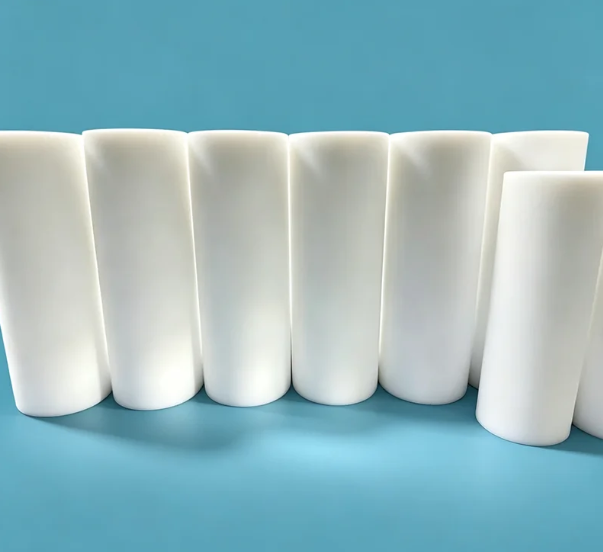
Heated acid service exposes ordinary thermoplastic and metal piping to conditions it was never built to handle. Once temperatures climb past roughly 70–90°C, common polypropylene softens and unlined steel corrodes fast enough to turn a routine transfer into a leak or a sudden failure. The problem sharpens at joints, bends, and pump connections, where thermal expansion and acid attack overlap in ways that standard tubing simply cannot absorb.
The material decision changes quickly when heat is involved. PFA- or PTFE-lined steel can carry many aggressive acids, but the liner needs adequate thickness and a sound bond to avoid collapse or separation during repeated thermal cycling. For chloride-bearing or strongly oxidizing streams, alloys such as Hastelloy C-276 or C-22 often earn their cost, while silicon carbide can be a stronger fit in mixed-acid or abrasive slurry service. The workable option depends on the exact acid concentration, temperature range, and whether the line will see pressure spikes or vacuum conditions.
Thermal expansion is usually the detail that separates a reliable heated acid line from one that fails early. Proper support spacing, expansion loops, and connections that avoid concentrating stress at flanges or welds matter as much as the base material. Watching pipe-wall temperature rather than only tank temperature helps too, because a hot spot near a heat exchanger or steam trace can push an otherwise suitable material beyond its limit.
Rod Stock That Holds Tolerance After Machining
Rod stock that holds tolerance after machining is not just about the alloy spec on paper. It comes down to how the material behaves once the outer skin is peeled away. Internal stress from the mill can stay locked in the bar, and when you turn, mill, or drill into it, that stress lets go unevenly. The result is a part that drifts a few tenths or even a couple thousandths after it comes off the machine. Shops that do tight work tend to pay more attention to how the rod was straightened, stress-relieved, and cut to length than to the listed chemistry alone.
A good starting point is buying stock that has been cold finished with a controlled straightening pass, since heavy roller straightening can work-harden the surface and leave a stressed shell. Stress-relieved grades, often marked SR or with a specific temper, give you a more predictable core to cut into. When you rough a part, leave a little for finish passes, and let the stock sit if the tolerance is extremely tight—this lets the material relax before your final cuts. This approach works especially well for turned pins, bushings, and short shafts where post-machining movement can scrap an entire batch.
In practice, you can spot rod that holds size by how it behaves in a repeat job. If the first couple of parts come off stable and the next ten don't need constant offset tweaks, the stock is doing its job. Some machinists also prefer certain diameters or lengths because the material seems to settle faster. The key is to track what runs clean in your shop and stick with suppliers that give you consistent bar end to end, not just a pretty certificate.
Inert Performance Without Coatings or Additives
Materials that remain truly inert tend to disappear into the background of a process. They do not leach, react, or shift under load because there is nothing added to the surface that could break down over time. This absence of coatings and additives removes a common failure point: the interface between the base substrate and whatever was applied to it.
Without a coating to delaminate or an additive to migrate, performance stays stable across broad temperature and chemical swings. The surface behaves the same on first contact as it does after thousands of cycles, which simplifies validation and reduces the need for incoming inspection. It also means there is no trade-off between purity and durability.
In practical use, this translates into fewer variables when something does need troubleshooting. The material itself is the only thing interacting with the process stream, so any change can be traced to conditions rather than a hidden layer wearing away. Engineers tend to value that kind of directness because it removes guesswork from long-term system design.
Thermal Expansion That Won't Surprise Your Assembly
Most thermal expansion surprises come from a simple mismatch: the designer chose a coefficient from a handbook, the machinist held a tight tolerance at room temperature, and the assembly sees a temperature swing no one talked about. The result is either a press fit that vanishes at operating heat or a locating pin that binds after a cold soak. Instead of treating expansion as an afterthought, work backward from the actual temperature range the part will see in service, not the lab. If a shaft and housing have different rates, calculate the real clearance at both extremes and leave room for the less predictable direction of change.
A practical trick is to design in a deliberate sacrificial gap or a flexible constraint rather than trying to eliminate movement altogether. For example, a bearing seat can use a slightly oval bore or a wave washer that absorbs axial growth without fighting the housing. When two materials must stay aligned, pick a common reference plane and let the free ends float. That way, expansion happens where you expect it and does not stack up into a hidden interference.
It also helps to question the standard tolerances. A dimension that is perfectly acceptable at 20°C may be useless if the part regularly runs at 120°C. Instead of tightening every tolerance, shift the nominal size so the thermal growth lands in the middle of the acceptable fit range. This keeps machining costs reasonable and removes the need for selective assembly. A quick hand calculation or a simple spreadsheet with the two coefficients and the temperature delta is often enough to prevent a field failure that would otherwise look like a manufacturing defect.
Sizing Tube and Rod for Long-Term Chemical Duty
Long-term chemical exposure rarely fails a tube or rod because the base material was slightly off; it fails because the dimensional choice left no room for what the environment actually does over time. Wall thickness should be treated as a consumable allowance, not a static property. Start with the minimum pressure and temperature rating, then add separate margins for uniform corrosion, pitting depth, and any known erosion from slurry or high-velocity flow. For rods used as valve stems or agitator shafts, diameter is less about pressure containment and more about bending stiffness and unsupported span. A rod that survives chemically can still gall, flex, or creep if its section is too slim for the operating temperature and side loads.
Thermal cycling and chemical attack tend to work together in ways that catch undersized cross-sections early. A heavier wall or larger diameter slows the rate at which stress cracks propagate from surface defects, and also reduces the stress intensity at threads, grooves, and sealing faces. Where fittings or compression sleeves are involved, verify the actual outside diameter tolerance rather than the nominal size, because cold flow and chemical softening can turn a slightly undersized tube into a leak path within months. For polymer and fluoropolymer materials, use the manufacturer's chemical resistance data at the highest expected temperature, not at room temperature, and derate the pressure rating accordingly.
In practice, it is better to compare several candidate dimensions under the same worst-case scenario than to fine-tune a single size around ideal conditions. Calculate the hoop stress, check the unsupported length for buckling or sag, and then review whether the chosen size can be safely machined or assembled without creating stress concentrations. A modest increase in tube wall or rod diameter often costs less than premature replacement, unplanned downtime, or a secondary containment failure.
FAQ
PTFE resists nearly all industrial chemicals except a few molten alkali metals and fluorine compounds under pressure. Its carbon-fluorine bonds are extremely stable, so acids, solvents, and caustics won't attack the tube even at elevated temperatures. This makes it reliable for dosing, sampling, and transfer lines in chemical plants.
Typically from -200°C up to 260°C for continuous use, with short excursions slightly higher. The material doesn't become brittle at cryogenic temperatures and doesn't soften under normal high-temperature process conditions, which is why it works in both cryo and heat-intensive setups.
Rods are solid stock used for machining seals, bushings, insulators, and custom components, while tubes are used for fluid or gas transfer and protective liners. Both share the same chemical and thermal resistance, but rods are chosen when you need a solid, machinable shape that can handle compressive loads or be turned into precise parts.
Yes. PTFE is relatively soft and machines cleanly with sharp tooling. The chemical and thermal properties are inherent to the material, not a surface treatment, so cutting, drilling, or turning does not create a weak point where chemicals can attack. That's why workshops can produce bespoke fittings, valve seats, and gaskets from rod stock.
Many grades are available with FDA-compliant or USP Class VI certifications. Virgin PTFE contains no plasticizers or additives that could leach, which is important for pharmaceutical, food, and semiconductor processes where contamination must be avoided. Always confirm the specific grade and documentation with the manufacturer.
Chemical processing, oil and gas, pharmaceuticals, food and beverage, semiconductor manufacturing, and power generation. In each case the material is chosen because it solves a specific problem: corrosion, sticking, thermal degradation, or contamination.
Keep them away from sharp objects, direct flame, and prolonged UV exposure. PTFE can deform under sustained mechanical load, so store rods flat and tubes without heavy stacking. Clean with deionized water or a mild detergent before installation in sensitive systems. Avoid cutting with dull tools that generate excessive heat.
It has a relatively high coefficient of thermal expansion and can creep under load, so design should account for movement and support. It is also not recommended for use with molten alkali metals or certain fluorinating agents. In high-wear or high-pressure situations, filled grades or alternative fluoropolymers may be more appropriate.
Conclusion
Process engineers who move aggressive chemicals every day quickly learn that generic fluoropolymer stock is not a guarantee of reliability. In heated acid lines, standard tubing can soften, swell, or develop stress cracks once temperature and concentration shift together. PTFE tube and rod addresses that by remaining inert without relying on surface coatings or additive packages, so there is no thin protective layer to wear through or leach into the process stream. The material’s low extractable profile keeps aggressive feedstocks from attacking the line, while its wide service range holds up when hot acids, caustics, or solvents become routine rather than occasional.
Machinists get a different benefit from the rod side. Because PTFE rod stock holds dimensional stability after machining, close-tolerance seals, bushings, valve seats, and gaskets can be produced without the part drifting out of spec once it leaves the shop. Thermal expansion is predictable enough to plan for instead of discovering after assembly: growth rates can be calculated and accounted for in flange gaps, retained fits, and long straight runs. Selecting the right tube and rod dimensions for continuous chemical duty means matching wall thickness, diameter, and length not just to flow requirements but to the sustained temperature, pressure cycling, and mechanical load the system will actually see.
Contact Us
Contact Person: Tommy Xiao
Email: [email protected]
Tel/WhatsApp: 8615651509888
Website: https://www.ptfe-factory.com